
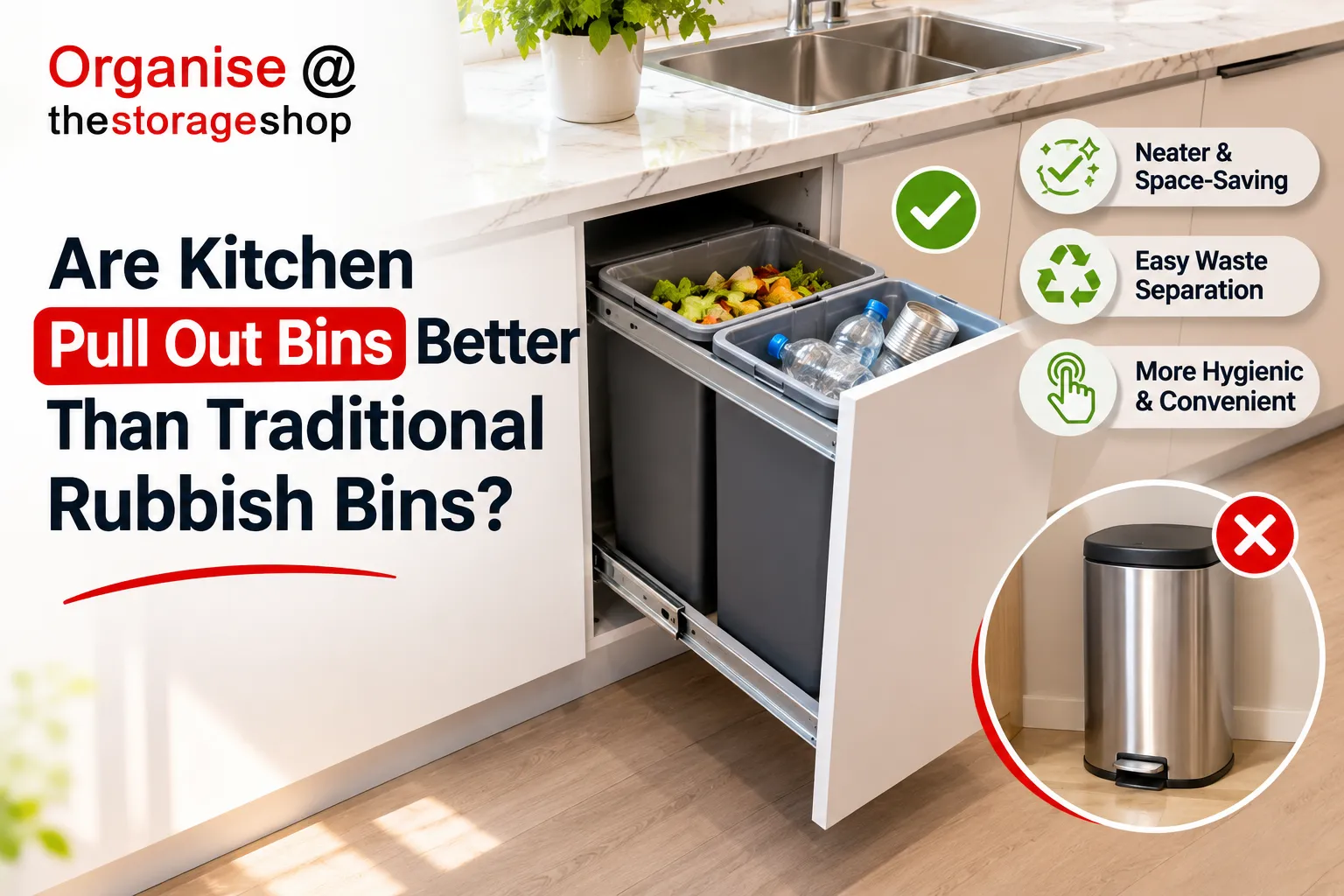
Short answer: For most kitchens, yes. Kitchen pull out bins free up floor space, hide the mess and make it easier to keep rubbish, recycling and food scraps apart. A traditional freestanding bin still makes sense if you rent, want to spend less, or simply don’t have a spare cupboard.
The kitchen bin rarely gets planned. It ends up wherever there’s a gap, beside the fridge or at the end of the bench, and stays there for years. Then the council hands out a green food-waste caddy, the recycling crate moves in next to it, and suddenly three containers are fighting over the same corner.
That’s usually when people start looking at pull out systems. Here’s how the two options compare in everyday use.
How a kitchen pull out bin works
A pull out bin lives inside a base cabinet. The buckets sit in a metal frame on runners, and the frame is fixed either to the cupboard floor or to the back of the cupboard front.
-
Base-mounted: you open the hinged door, then pull the bin forward by its handle. These are easy to retrofit into an existing cupboard, including under the sink.
-
Door-mounted: the cupboard front works like a drawer front, so one pull brings the front and the buckets out together.
Most units have two or three buckets. Larger ones go up to four.
Where pull out bins come out ahead
You get your floor back
A freestanding bin takes up a patch of floor roughly 30 by 40 centimetres. That doesn’t sound like much until it’s the exact spot you stand on to load the dishwasher. In galley kitchens and apartments, moving the bin into a cupboard makes the walkway far easier to use.
Sorting waste gets simpler
This matters more every year. Many Australian councils now collect general waste, yellow-lid recycling and food organics (FOGO) separately. A double or triple pull out rubbish bin keeps every stream in one cabinet instead of three bins on the floor. You can compare two- and three-bucket models in the pull out rubbish bin range.
The kitchen looks tidier
With the door shut, nothing gives the bin away: no smudged lid, no bag edge hanging over the rim. It works especially well with streamlined, handleless cabinetry.
It sits where the mess happens
Fit the bin in the cabinet beside your prep area or sink and you can sweep peelings straight off the chopping board. It’s a small thing, but you’ll notice it every time you cook.
Where traditional bins still make sense
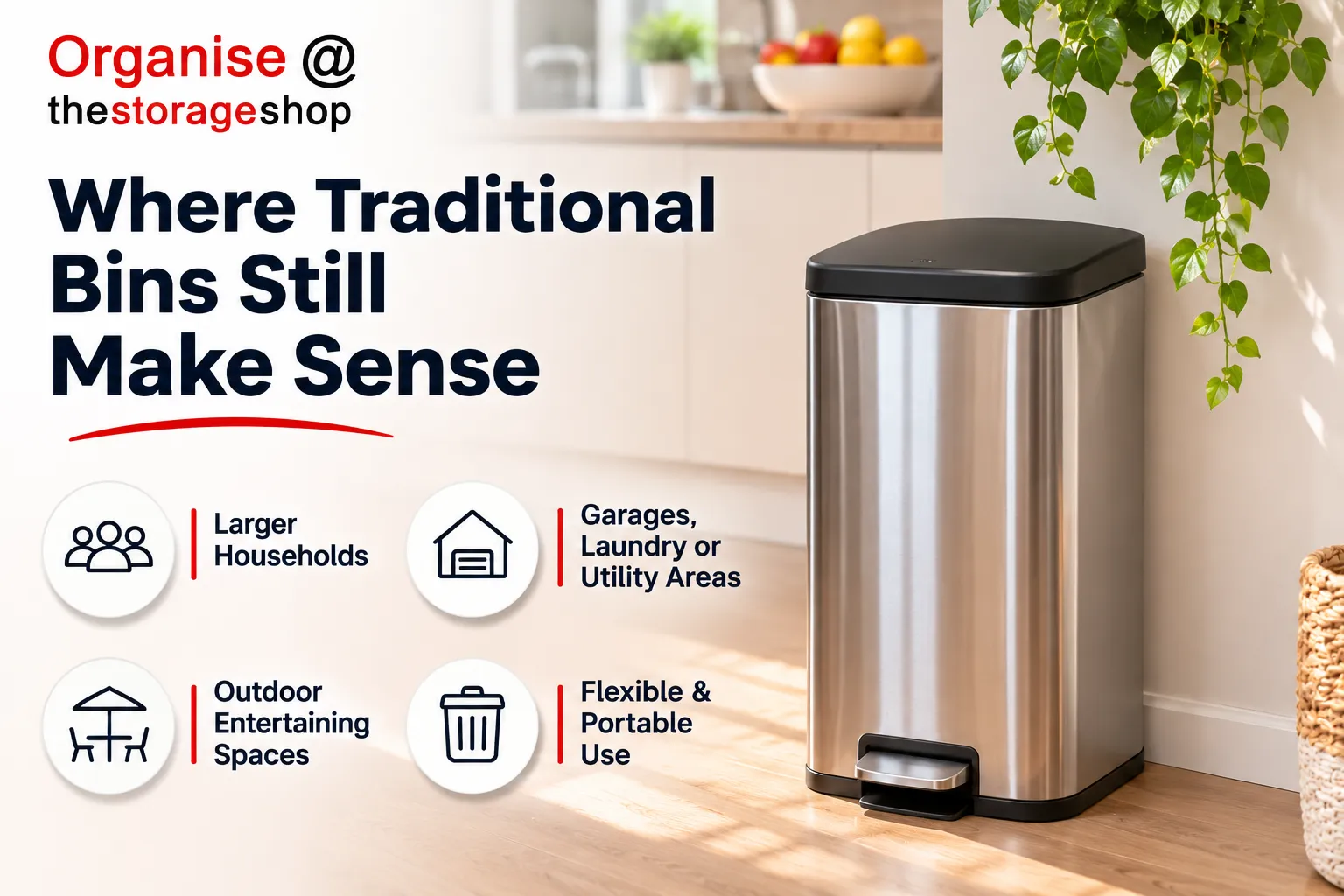
Freestanding bins have genuine advantages:
-
Lower cost. There’s no frame, runner set or fitting to pay for.
-
No installation. Ideal for renters or anyone who can’t drill into their cabinets.
-
Portable. You can move it for parties, cleaning or a kitchen reshuffle.
-
Not limited by cupboard size. You can buy a 50-litre bin even if your cabinets are narrow.
The trade-off is that it’s always on show, and it takes up floor you then have to clean around.
Pull out bins vs traditional bins at a glance
|
Kitchen pull out bin |
Traditional bin |
|
|
Where it sits |
Inside a base cabinet |
On the floor |
|
Visible |
Hidden when closed |
Always |
|
Installation |
Needed |
None |
|
Recycling and FOGO |
2–4 buckets in one unit |
Usually separate bins |
|
Moving it |
Fixed in place |
Easy |
|
Upfront cost |
Higher |
Lower |
On hygiene, neither type wins automatically. What counts is emptying the bins often, using liners and washing the buckets now and then. With a cupboard bin, a wipeable mat on the cabinet floor catches drips before they reach the board.
Short on space? Consider a kitchen door bin
No spare cabinet? A kitchen door bin might be the answer. These smaller bins, usually 5 to 20 litres, hang on the inside of a hinged door and swing out as it opens. Some models lift their lid automatically.
They suit food scraps, narrow cupboards, and sink cabinets where pipes leave too little room for a full frame. Check your hinge position and door clearance first, then browse kitchen door bin styles to find one that fits your door.
Measure before you buy
Cabinet sizes on kitchen plans are external measurements. Side panels are usually 16 mm thick, so a 450 mm cabinet is only about 418 mm wide inside. Measure the internal width, depth and height. Under the sink, measure from the cupboard floor to the lowest point of the waste pipe.
As a rough guide, this is the capacity each standard cabinet width can take:
|
Cabinet width |
Typical pull out bin capacity |
|
300 mm |
16–34 L |
|
400 mm |
20–64 L |
|
450–500 mm |
34–76 L |
|
600 mm |
74–94 L, up to four buckets |
Look at the runners too. Full-extension, soft-close runners rated for a loaded bin hold up better over time, while budget runners can start to sag under a full bucket. Base-mounted bins are usually a simple DIY job. Door-mounted systems take more care to align, so some homeowners ask a cabinetmaker to fit them.
Frequently asked questions
Can a pull out bin go under the sink?
Yes, as long as there’s enough clearance below the waste pipe. Low base-mounted bins and door bins are made for exactly this spot.
How many litres does a household need?
Couples usually get by with 30–40 litres. Families sorting recycling and food waste are better off with 50 litres or more, split across two or three buckets.
Is the extra cost worth it?
For most homes, yes. You open the bin several times a day, so the higher price is spread over years of use.
So, which should you choose?
If you own your home and have a spare base cabinet, a kitchen pull out bin is the more practical long-term choice, especially if your council collects recycling and food waste separately. If you rent, want the cheapest option or have no free cupboard, a good freestanding bin will do the job. Somewhere in between, a door bin handles food scraps without any renovation.
Start with a tape measure, not the product photos. The right bin is the one that fits your cabinet and the way your household actually throws things out.